According to the Prime Framework, any system of sufficient mass will naturally evolve so that one or more 2nd order entities will emerge and accumulate the majority of mass or influence within the system. This occurs as a result of the simple multiplication of elements over time.
Typically, the first entity in such a system will gain an advantage, leading to its expansion. System stability, evidenced by the typical distribution of apparently stable systems across various domains, generally aligns with a distribution between 70%/20%/10% to 80%/20%, while expansion of the 2nd order beyond 80% may result in system destabilization.

Visual representations of a 9-node system in which nodes are connected to their multiples and factors.
In the context of the solar system, gravity serves as the fundamental mechanism for interaction, with the sun as its source. The sun’s gravitational influence extends to all entities within the system, shaping their interactions.
According to the core accretion model of the solar system’s early formation, Jupiter was the first massive body to begin accumulating significant mass, placing it firmly in the 2nd order. The earliest matter to accumulate can be represented numerically by the number 2, with subsequent matter represented by 4, 8, 16, and so on. This matter primarily contributed to the formation of Jupiter, first composing its core and then accumulating into the gas that surrounds it, forming the gas giant we know today. As a result, Jupiter, as the 2nd order entity, comprises approximately 71% of the planetary mass in the solar system, more than twice the mass of all the other planets combined.

Accretion disk, source: Wikipedia.org
The next significant body to accumulate mass was Saturn, which occupies the 3rd order, represented by numbers 3, 6, 9, and so forth. Gravitational interaction between the growing Jupiter and early Saturn gave an ‘advantage’ to Jupiter in mass development, though this advantage was not so extreme as to prevent Saturn from developing. However, because Jupiter occupied the 2nd order, less mass was available for Saturn in the 3rd order, leading to slower growth. Today, in our stable solar system, Saturn accounts for roughly 21% of the planetary mass.
Later in the system’s development, Neptune and Uranus formed, each representing unique Prime orders (5 and 7). However, by this time, most of the available mass had already been absorbed by Jupiter and Saturn in the 2nd and 3rd orders, leaving less for Neptune and Uranus. As a result, these planets collectively gathered only 7% of the available mass.
The remaining orbiting bodies in the solar system comprise a negligible (~1%) amount of mass compared to the first four planets and represent the multiplication of higher-order Prime nodes (such as 11, 13, 17, 19, and beyond). Earth, for example, could be considered a high Prime node, representing significant novelty within the system as the only inner terrestrial planet with surface water, a stable magnetic field, and advanced life.

Planet sizes, source: NASA
The overall distribution of mass in our relatively stable planetary system is approximately 71/21/7, which aligns well with the Prime Framework’s prediction of stable systems. It could also be hypothesized that the injection of significant external matter into the system might push Jupiter beyond its point of stability, leading to a collective destabilization of the system and a potential ‘bursting’ of the planetary ‘bubble.’

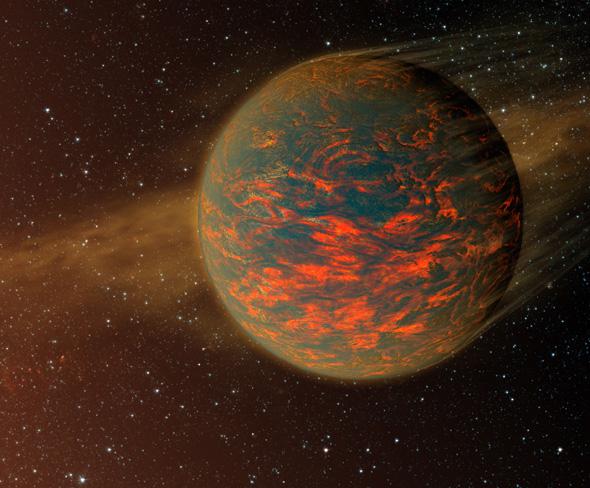
55 Cancri e, source: Slate
Interestingly, at least one exoplanetary system resembles our own: the system surrounding 55 Cancri A. This system is believed to be about 10 billion years old, much older than our own, and exhibits an apparent distribution of 76/16/6, with two large gas giants occupying the 2nd and 3rd orders. The Prime orders contain only a very small fraction of the planetary mass. This seems to support the idea that system stability occurs around the 80/20 distribution, although we cannot directly observe the system’s evolution, as astronomical changes occur over billions of years.

Further examination of other exoplanetary systems could provide additional testing grounds for the Prime Framework in the context of planetary mass evolution in star systems. However, discovering exoplanetary systems remains challenging, and our ability to accurately measure those we have found is still developing. As technology advances, we may eventually determine whether the stable distribution of mass in any astronomical system indeed lies within the 80/20 range. Until then, we must focus on systems that are much younger and closer to home.

 "conduit"